
Direct-from-Factory Mini Excavators: The Verification Guide Smart Buyers Wish They Had Earlier
If you are considering a direct-from-factory mini excavator order, start with one simple truth: you are not only buying a machine. You are buying a production process, a documentation trail, a quality-control routine, and a support relationship. You can begin by reviewing our mini excavator manufacturing service, then ground your equipment knowledge with a neutral reference such as Wikipedia’s excavator overview, which explains the core structure, hydraulic functions, and attachment roles of excavating equipment.
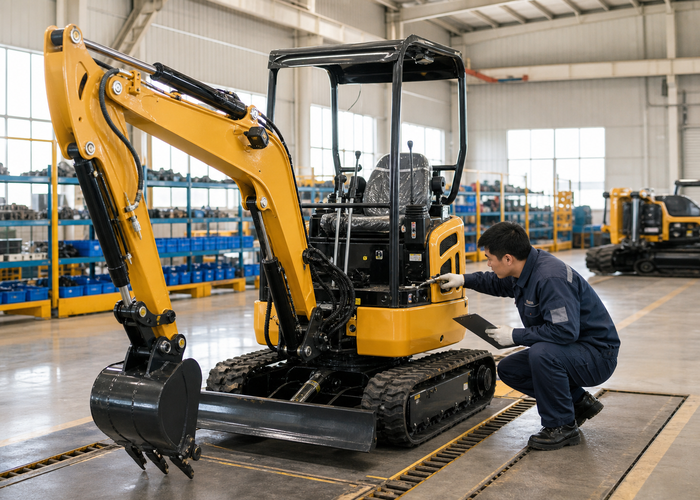
Most buyers ask whether buying direct from factory is “worth it.” As a mini excavator technical specialist, I would ask a better question: can you verify that the exact machine you receive will match your work, your market, and your maintenance reality? If you cannot prove that yet, this guide gives you a practical way to check a mini excavator manufacturer before you commit.
Start With the Job, Not the Machine
A strong purchase begins with your worksite. Before comparing models, define what the mini excavator must do over the next two to three years. Will you dig utility trenches, prepare landscape beds, clean farm drainage, remove small stumps, load loose material, or run a hydraulic attachment? Each task changes the machine you should buy.
Use this quick work profile before you contact any factory:
| Buyer Question | Why It Matters | What to Ask the Factory |
|---|---|---|
| What material will I dig most often? | Soil type affects bucket choice and hydraulic demand. | Which bucket sizes and tooth options fit this model? |
| What is my narrowest access point? | Machine width decides whether it can enter the site. | What are the exact track and blade widths? |
| What depth do I need regularly? | Rated digging depth must match real work. | Can you provide the digging envelope drawing? |
| Which attachments will I use? | Attachments require matching flow, pressure, and coupler size. | What auxiliary hydraulic data is supplied? |
| Who will maintain it? | Service difficulty affects long-term uptime. | Can you provide manuals, parts diagrams, and service videos? |
When your job profile is clear, browse Gotrum Gear’s main mini excavator site with a more technical eye.
What “Direct From Factory” Really Changes
Buying direct from factory can shorten the purchasing chain. You may communicate closer to production, request configuration details earlier, and ask for inspection evidence before shipment. The trade-off is responsibility: you must judge whether the factory has stable production, clear documentation, repeatable testing, and support for your market.
At minimum, request evidence in six areas:
| Verification Area | Evidence to Request |
|---|---|
| Factory identity | Business registration, production address, workshop photos, live video call |
| Machine specification | Model sheet, dimension drawing, engine data, hydraulic data, operating weight |
| Quality process | Welding inspection, assembly checks, hydraulic leak test, test-run procedure |
| Compliance | Engine/emission documents, safety labels, destination-market documents |
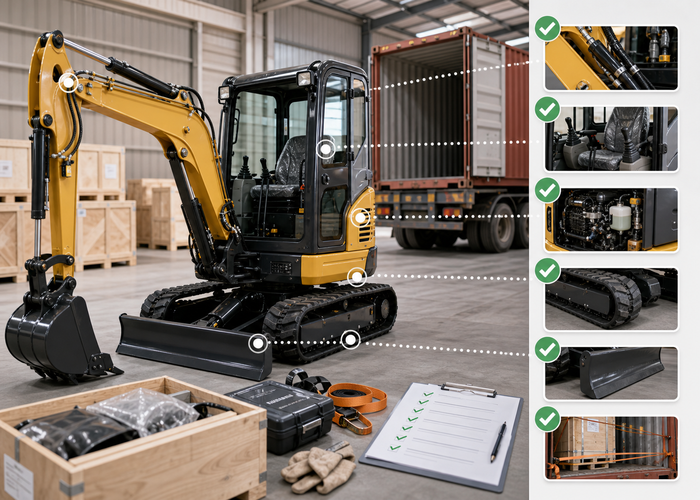
| Shipment readiness | Packing method, container loading photos, serial number record |
| After-sales support | Parts list, service manual, warranty scope, spare parts process |
The World Trade Organization’s preshipment inspection page reinforces a useful idea: inspection should be objective, documented, and based on clear criteria.
Build a Mini Excavator Quality Checklist Before Production
Create your mini excavator quality checklist before production begins. If you wait until the machine is packed, your ability to correct problems is limited.
Your checklist should cover structure, hydraulics, power system, controls, and serviceability.
For structure, ask for photos or video of the chassis, boom, arm, blade, welds, pin areas, and track frame. You can still check whether welds look consistent, high-stress areas are reinforced, and the machine appears symmetrical.
For hydraulics, focus on hose routing, fittings, cylinders, auxiliary lines, and leak checks during operation. A compact excavator is only as useful as its hydraulic response. Slow movement, uneven boom control, weak swing, or visible seepage should be treated as inspection findings.
For the power system, request engine information, emission-related documents, air filter access, cooling layout, fuel system layout, and service intervals. If you import into the United States, the U.S. EPA guidance on importing vehicles and engines is important because nonroad engines may need to meet applicable requirements.
For controls, ask for a cold start video, travel test, swing test, blade test, boom/arm/bucket cycle, and auxiliary-line test if ordered. The operator should demonstrate the machine under real motion, not only start it for a few seconds.
Use a Three-Gate Verification System
Instead of asking, “Is this supplier reliable?” use three gates. Each gate must be passed before you move forward.
| Gate | Timing | What You Verify | Pass Standard |
|---|---|---|---|
| Gate 1: Supplier Verification | Before deposit | Factory identity, model match, communication clarity | The factory can prove who they are and what they will build. |
| Gate 2: Production Verification | During or after assembly | Serial number, configuration, visual build quality, function test | The machine matches the agreed specification and runs correctly. |
| Gate 3: Shipment Verification | Before loading | Packing, parts, manuals, labels, documents | The inspected machine is protected and traceable for shipment. |
This system protects you from vague confidence. Friendly communication, attractive photos, and fast replies are helpful, but they are not proof. Proof is a file of documents, images, videos, serial numbers, and test results.
On our About page, we describe mini excavator production as a design-and-manufacturing responsibility. Apply the same mindset to sourcing: every claim should be verified by data, images, documents, or a controlled test.
What to Request in a Pre-Shipment Inspection
A pre-shipment inspection should be more than a few polished photos. You need an ordered inspection package proving the machine is complete, functional, and ready to ship.
| Inspection Item | What the Evidence Should Show |
|---|---|
| Nameplate and serial number | Clear identification tied to your order documents |
| Full-machine walkaround | All sides, undercarriage, counterweight, blade, boom, arm, bucket |
| Engine compartment | Wiring, hoses, filters, battery, cooling system, labels |
| Hydraulic compartment | Pump area, tank, fittings, visible leak check |
| Function test | Travel, swing, boom, arm, bucket, blade, auxiliary line |
| Track test | Forward, reverse, left/right turn, track tension view |
| Attachment fit | Bucket pins, coupler, thumb or auxiliary attachment if ordered |
| Manuals and documents | Operation manual, parts list, packing list, compliance documents |
| Packaging | Rust prevention, tie-down points, crate or container preparation |
If a factory cannot provide this package, ask why. Sometimes the issue is only workflow. Sometimes it reveals that inspection is not mature enough.
The U.S. Customs and Border Protection basic import/export guidance is also worth reading if you import into the United States. Your invoice, packing list, model description, and documents should be consistent before the machine moves.
Watch the Factory Process, Not Just the Finished Machine
A finished mini excavator can look clean in a photo. The process tells you more. Ask for short videos from production stages such as steel cutting, welding, painting, hydraulic installation, electrical installation, final assembly, and test operation.
Use the video below as a neutral learning reference. Use factory footage to sharpen your own questions: How are welds checked? How is hydraulic leakage tested? Are machines test-driven before packing? Are serial numbers recorded?
The Risk Map: Where Direct Buyers Get Surprised
Direct sourcing is manageable when handled carefully, but unforgiving when handled casually. The most common risks are predictable.
| Risk Area | Severity | How to Reduce It |
|---|---|---|
| Specification mismatch | High | Confirm model sheet, drawings, photos, and serial number before shipment. |
| Engine or emissions mismatch | High | Confirm destination-market requirements early. |
| Weak after-sales support | High | Request manuals, parts list, consumables, and response process before order. |
| Shipping damage | Medium | Require packing photos, tie-down evidence, and loading records. |
| Attachment incompatibility | Medium | Confirm pin size, coupler type, hydraulic flow, and pressure. |
| Missing documentation | Medium | Use a document checklist before final payment. |
If you still have vague job requirements, supplier photos only, assumed compliance, or a verbal support promise, pause the purchase and improve your evidence file.
Do Not Ignore Safety and Worksite Reality
Even a well-built mini excavator must be used responsibly. If your machine will be used for trenching, foundation preparation, or utility work, safety planning matters as much as machine selection. The OSHA trenching and excavation safety publication explains major hazards such as cave-ins and unsafe conditions around trenches.
From a technical perspective, this affects your purchase. If you will trench regularly, ask for the right bucket width, stable undercarriage, smooth control, visibility, and blade performance. If new operators will use the machine, request training materials and clear maintenance instructions.
Factory Questions That Reveal More Than a Brochure
When you talk to a mini excavator manufacturer, ask questions that force specific answers.
| Question | Good Answer Looks Like |
|---|---|
| Which parts are made in-house and which are purchased? | Clear explanation of major assemblies and supplier control |
| What test is performed before shipment? | A defined checklist, not “we check everything” |
| Can you show my machine’s serial number during testing? | Yes, with video evidence |
| What hydraulic flow and pressure are available for attachments? | Specific values and compatibility guidance |
| What documents will ship with the machine? | Manual, parts list, packing list, compliance documents, inspection record |
These questions change the conversation. A capable supplier becomes more specific as your questions become more technical. For more buyer education, visit the Gotrum Gear blog.
Compare Factory Offers Without Looking at Price
Because a serious sourcing decision should not depend only on price, compare offers by evidence:
| Category | Weight | What to Score |
|---|---|---|
| Job fit | 20 | Size, digging depth, width, bucket options, attachment compatibility |
| Build evidence | 20 | Welding, hydraulic routing, test videos, serial-number proof |
| Documentation | 15 | Specification sheet, manual, parts list, compliance documents |
| Factory communication | 15 | Technical clarity, response quality, willingness to verify |
| Shipment protection | 10 | Packing method, loading photos, rust prevention, tie-down plan |
| After-sales support | 20 | Parts access, service guidance, warranty clarity, troubleshooting process |
If one supplier gives you a polished quote but weak evidence, and another provides a complete technical file, the second option may be stronger. Your goal is to receive a working asset with predictable support.
A Practical Buyer Workflow
Use this workflow:
| Step | Action | Output |
|---|---|---|
| 1 | Define your work profile | Job list, soil type, access limits, attachments |
| 2 | Shortlist machine size | Operating weight, digging depth, width, hydraulic needs |
| 3 | Verify supplier | Factory identity, video call, production evidence |
| 4 | Lock specification | Signed model sheet and configuration list |
| 5 | Confirm compliance | Destination-market engine and safety documents |
| 6 | Request inspection plan | Photo/video checklist before shipment |
| 7 | Review shipment proof | Packing, serial number, loading and document consistency |
| 8 | Prepare receiving plan | Unloading, first inspection, fluid checks, operator orientation |
If you want help turning this into an inquiry, start from the Gotrum Gear contact page and prepare your work profile before you send a message.
Final Technical Advice
A direct-from-factory mini excavator purchase should feel less like shopping and more like controlled procurement. Before approving shipment, make sure you can answer five questions with evidence: Is this the exact machine I ordered? Does it function correctly? Is it suitable for my work? Can I import and operate it responsibly? Can I maintain it after delivery?
When those answers are clear, direct-from-factory sourcing becomes a disciplined process, not a gamble. To continue building your equipment plan, return to our mini excavator resources and services, and keep authoritative safety guidance such as the CDC/NIOSH trenching safety page in your reference file before the machine reaches the jobsite.
FAQ
Q1: Is buying a mini excavator direct from factory a good idea? Yes, if you verify the factory, lock the specification, request pre-shipment inspection evidence, confirm destination-market documents, and prepare an after-sales support plan. It is not a good idea if you rely only on product photos.
Q2: What is the most important thing to check before shipment? Confirm that the exact machine tied to your serial number matches the agreed specification and passes a full function test. Request walkaround video, nameplate photos, hydraulic function testing, travel testing, attachment-line testing, and packing evidence.
Q3: Which documents should I request from a mini excavator manufacturer? Request the specification sheet, dimension drawing, engine information, operation manual, parts list, packing list, commercial documents, compliance documents for your destination market, and a final inspection record.
Q4: How can I verify a mini excavator supplier remotely? Use a live video call, request factory identity documents, ask for workshop videos, compare the production address across documents, request production-stage photos, and require serial-number proof during inspection.
Q5: What should be included in a mini excavator quality checklist? Include structure, welds, undercarriage, track tension, engine access, hydraulic hoses, cylinders, fittings, controls, auxiliary lines, bucket and pins, blade operation, electrical components, manuals, spare parts, packaging, and shipment documents.
Q6: Should I check regulations before importing a mini excavator? Yes. Engine emissions, customs documentation, safety labeling, and local worksite rules may apply depending on your destination market. Review the relevant rules before shipment.
Q7: Why should I avoid choosing only by machine appearance? A clean-looking mini excavator can still have weak documentation, poor hydraulic routing, missing support, or unsuitable specifications. Verification requires test evidence, documents, and a service plan.
Q8: What is a practical first step before contacting a factory? Write your work profile: job type, digging depth, access width, soil type, attachment needs, operator experience, maintenance capability, and destination market. Send that profile with your inquiry.